Section 6.10 Implicit Surfaces
Objectives
Explore the relationship between partial derivatives and the derivative of parametric equations.
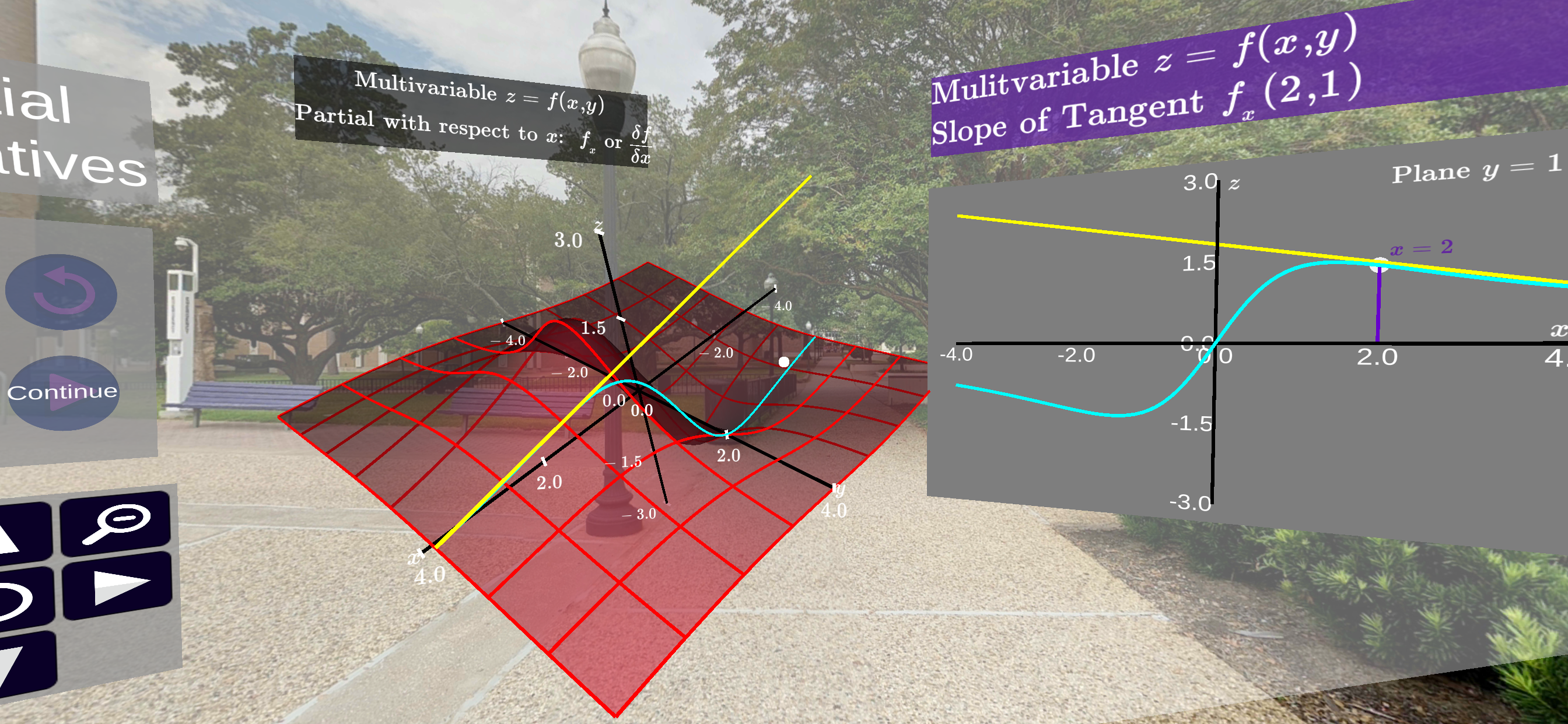
The CalcVR lesson defines partial derivatives and motivates this definition by examining the slope of tangent lines along level curves or traces in one of the independent variables. Several different surfaces are given as examples where the curves generated by holding one variable constant are highlighted. We have also examined the concept of derivatives of paths (or parametric equations) in Section 5.2. Both of these concepts involve a rate of change and thus should be connected.
Subsection 6.10.1 Connection to Vector Valued Functions
Example 6.10.2.
Consider the example of the multivariable function
First let's find the partial derivative at \((1,0)\text{.}\) The partial derivative of \(f\) with respect to \(x\) is given by
and at the point \((1,0)\) we have
Let's take another approach. If we consider the partial derivative at \((1,0)\text{,}\) we know that \(y\) is fixed at \(0\text{.}\) Referring back to Subsection 6.4.1 we should be able to find this path on the function. This can be accomplished by allowing
in \(\mathbf{r}(t) = \langle x(t), y(t), z(t) \rangle\text{.}\) This parametric equation follows the function along \(y=0\) and passes through \((1,0, 1)\) when \(t=1\text{.}\)
This parametric equation has a derivative, which we learned about in Section 5.2. The derivative at of this path is given by \(\mathbf{r}'(t) = \langle 1,0, \frac{-4t}{(t^2+1)^2} \rangle\text{.}\) At \(t=1\) (the value at which the path passing through \((1,0,1)\)), \(\mathbf{r}'(1) = \langle 1,0, \frac{-4}{(1^2+1)^2} \rangle = \langle 1,0, -1 \rangle \text{.}\)
Notice we have that
Let's rewrite this,
It is no coincidence that these are similar. The partial \(f_x(1,0)= \frac{-1}{1}\) can be interpreted using the typical \(\frac{\text{rise}}{\text{run}}\) for slope. This means at the point \((x=1,y=0)\) the rate of elevation change is \(-1\) (down 1) for a one unit change in the positive \(x\) direction. For the rate of change \(\mathbf{r}'(1) =\langle 1,0, -1 \rangle\) we can interpret the \(0\) as we are not changing in the \(y\) direction This corresponds to \(y\) being fixed when we consider partials with respect to \(x\text{.}\) The other values are interpreted the same as before. That is, a one unit change in \(x\) corresponds to an elevation change of \(-1\text{.}\)
You can explore the function and the partial with respect to \(x\) using the tool below.
Activity 6.10.1.
In this activity, we want to repeat the discussion above and work through a similar calculation for \(f_y\) at \((1,0)\) using the function \(f\) in (6.5.1).
(a)
Find the partial with respect to \(y\) at \((1,0)\text{.}\)
(b)
Fix \(x=1\) and find a parametric equation \(\mathbf{r}\) for the path that follows the function in the \(y\) direction.
(c)
At what value of \(t\) does the function \(\mathbf{r}\) pass through the point \((1,0,1)\text{?}\)
(d)
Find the derivative of \(\mathbf{r}\) at the value from the previous part.
(e)
Interpret both the partial derivative with respect to \(y\) at \((1,0)\) and the value of \(\mathbf{r}'\) from the previous part. Explain the relationship between the two.
(f)
Find an equation for the tangent line to \(\mathbf{r}\) at the point \((1,0,1)\text{.}\)
(g)
Use the tool below to graph the function, path, and tangent line on the same graph in order to confirm your answer is correct.